
Imagine your child on the lounge carpet. They roll from one end to the other, jump up, spin on the spot until they wobble, then bend over to look at you through their legs, giggling at the upside-down world. It can look like pure silliness. It is also a small workout for a sense most of us never think about, and vestibular activities for kids turn up in almost every Gym Wizards class.
Here is what that sense is, how a class gives it a workout, and some gentle ways to play with it at home.
The balance sense in the inner ear
Most of us learnt about five senses at school. In her analysis of the Gym Wizards programme, occupational therapist Tiffany Heaney explains that there are more, including the vestibular sense: the part of us that notices movement and which way is up.
Its sensors sit deep inside the inner ear. The report describes three tiny tubes filled with fluid, lying in the three directions a head can turn. When your child nods, tilts or spins, the fluid moves and tells the brain which way the head went. Two small organs nearby notice going up and down, speeding up and slowing down. The report compares them to a tiny accelerometer and gyroscope, the kind of motion sensors that also sit inside a phone.
What the vestibular sense does for a child
According to the report, this sense helps a child feel secure and confident in their body, so they can move, learn and play. It works behind the scenes in a few ways parents will recognise:
- Staying balanced. It notices small head movements when a child wobbles, so the body can make quick, automatic adjustments. We look at this in Balance for Kids: Why the Wobble Matters.
- Keeping the eyes steady. It helps the eyes stay on a target while the head moves. The report gives the example of jumping into a hoop: the eyes stay on the hoop while the head moves up, down and forward.
- Finding a spot when turning. When children learn half and full turns, they practise fixing their eyes on one spot so they finish the turn without feeling lost.
- Changing the energy. The report describes quick, turning movements as waking-up movements, and steady up-and-down jumps as movements that can help a child calm down.
How a class gives the inner ear a workout
The report notes that almost every exercise in the Gym Wizards curriculum asks something of this sense, because the head keeps changing position:
- Holding shapes. In body positions like the Superman, Bridge and Tuck Sit, children hold their head in different positions while keeping their shape.
- Rocking and rolling. In the Rock & Roll, children rock backwards and forwards while staying curled up. Forward rolls tip the head right over.
- Moving across the mat. In the One Legged Baboon Walk the head is almost upside down. Runs like the Cheetah Run get faster as children progress to harder versions.
- Jumping. Jumps over a skipping rope go forwards, backwards and side to side.
- Upside down and backwards. Backward rolls, cartwheels and the handstand series turn the world upside down. Moving backwards comes up regularly too, for example in the Ninja Parkour Kick-Back and the Backwards Safety Fall.
Speed and challenge build gradually. The report suggests that speeding up step by step, and learning to move backwards in a safe, playful group, may help some children who find this kind of movement unsettling feel more comfortable over time. Rolling and Ninja Parkour moves are also built on a strong middle: see core strength for kids.
Not every child loves to spin
Some children cannot get enough of spinning and rolling. Others are much more careful, and prefer to keep their feet on the ground. Children differ a lot here. At Gym Wizards, children first learn steady body shapes and then build up to rolling, turning and going upside down, step by step and at their own pace.
If you have concerns about how your child responds to movement, speak to your doctor or an occupational therapist.
Inner-ear play to try at home
You do not need special equipment, just a soft, clear space:
- Rock and roll: sit on a mat or carpet, hug your knees and rock gently backwards and forwards.
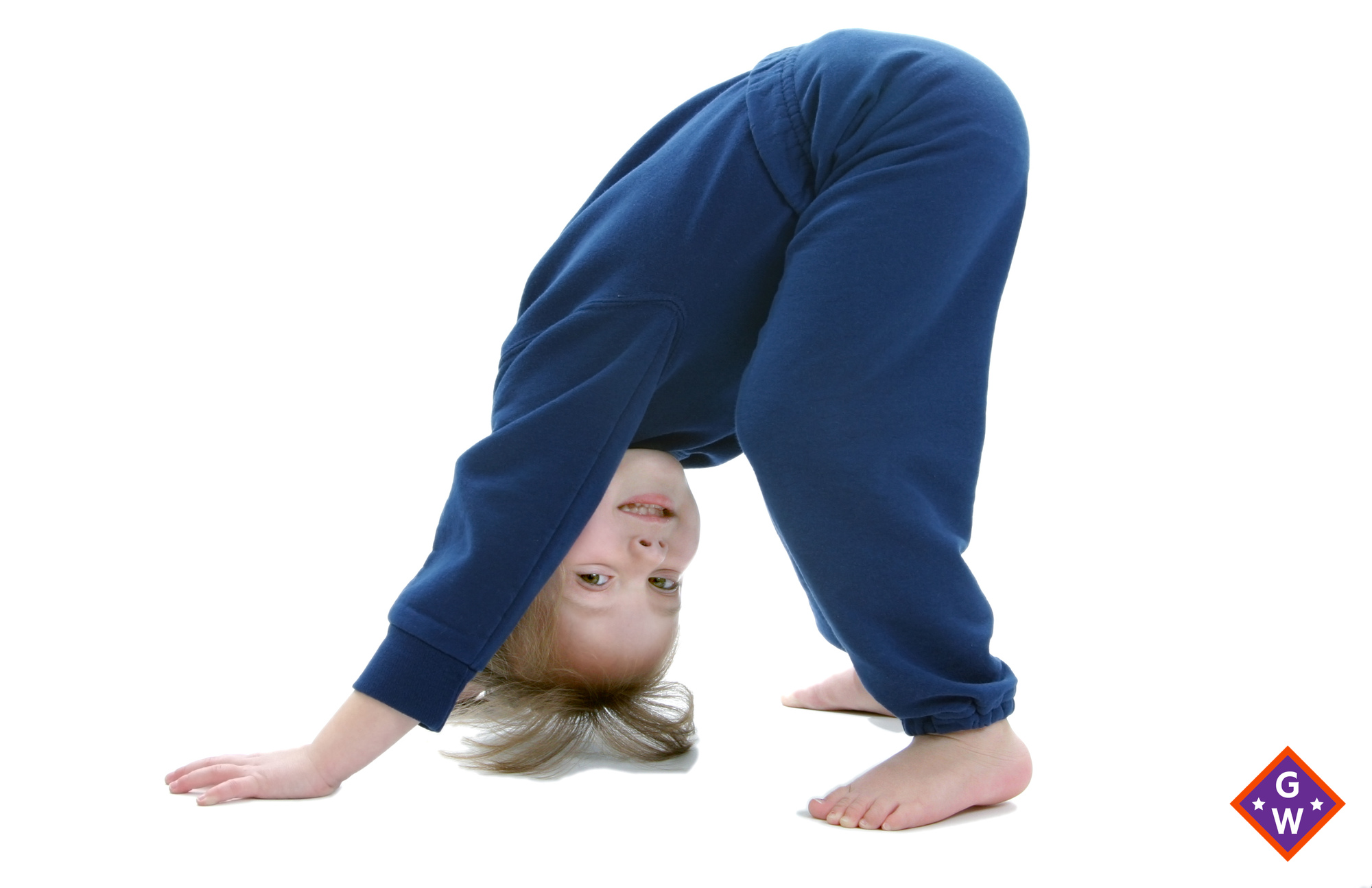
- Upside-down hello: stand with feet apart, put your hands on the floor like the child in the photo above, and peek at someone through your legs. Come up slowly.
- Spot it: choose a spot on the wall, do a small jump to turn halfway round, then find a new spot. Turn back and find the first one again.
- Line jumps: lay a skipping rope or a piece of string on the floor and jump over it forwards, backwards and side to side.
- Slow spins: turn slowly on the spot one way, stop and hold still like a statue, then turn the other way.
For more playful movement ideas, see our article on animal walks and body awareness.
Keep it gentle and let your child set the pace. Turn both ways, take breaks, and stop if your child feels sick or unsettled, or if the dizziness does not pass quickly. Never force spinning or going upside down, and leave rolls, especially backward rolls, for class with an instructor. These ideas are for fun at home and are not a treatment plan. If your child has an injury or is receiving therapy, check with their treating professional first.
Every roll is practice
Gym Wizards uses a progression-based curriculum, so children build skills step by step at their own pace. Rolling, turning and going upside down are not things to rush. They are part of the fun, practised a little more confidently each week.
Next time your child rolls across the lounge and comes up grinning, you will know their inner ear has been hard at work.
Ask your Gym Wizards instructor which roll or turn your child is working on this term.
New to Gym Wizards? If you are looking at gymnastics or Ninja Parkour classes in Cape Town, ask about a trial class. Our team can help you choose between Kenridge, Pinelands and Llandudno and explain the booking and payment steps.
Source note: This article draws on Tiffany Heaney’s October 2020 occupational-therapy analysis of the Gym Wizards programme, especially printed pages 3–4, 8–13, 18, 22 and 35. It describes opportunities to practise, not guaranteed developmental results. Gym Wizards does not replace occupational therapy, physiotherapy or speech therapy.