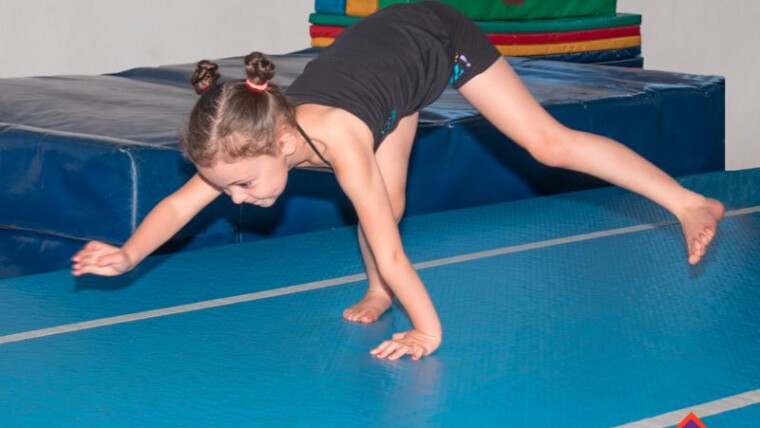

Imagine your child at a party, weaving through a room full of legs, chairs and balloons. They duck under a table, squeeze round a chair and step over a toy without looking down. Another day the same child walks straight into the door frame. Both moments say something about a skill that is still growing: spatial awareness for kids is the sense of where their body fits in the space around them.
Here is what spatial awareness is, how a class gives children lots of chances to practise it, and some easy games to play at home.
From body awareness to spatial awareness
In her analysis of the Gym Wizards programme, occupational therapist Tiffany Heaney describes body awareness as the sense of where all the parts of the body are and how they move, without having to look. We explore that in our article on animal walks and body awareness.
Spatial awareness takes the next step outwards. The report describes it as understanding the space around you in a way that reflects an understanding of your body in that space, and it explains that body awareness comes first. Children learn to judge what is their space and what is someone else’s. Everyday examples in the report include:
- walking around obstacles without bumping into them
- reaching out to pick up a pencil
- telling left from right
Over, under, around and through
Spatial awareness also has a language: over, under, around, through, next to, in front of, behind. The report suggests that moving their whole body over, under and around things gives children a way to make sense of these words, not just hear them.
The report also notes that children who are still building body awareness may bump into things more often, especially in places they do not know well, and may hold back from playground equipment. Every child is different, and a bumpy week is not on its own a reason to worry. If you have concerns about your child’s coordination, speak to your doctor or an occupational therapist.
How a class gives children space to practise
The report describes several ways the Gym Wizards curriculum asks children to move their bodies around objects and other people:
- Obstacle courses. Instructors set up blocks, trampolines, vaults and tumble tracks for children to hurdle, bounce and roll under, over and around.
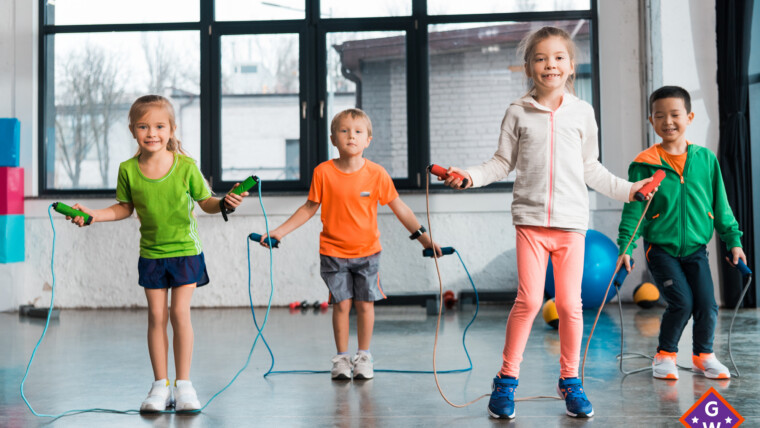
- Rope games. Children jump over a skipping rope with it between their feet, beside them, in front of them and behind them, and later run over it sideways in both directions.
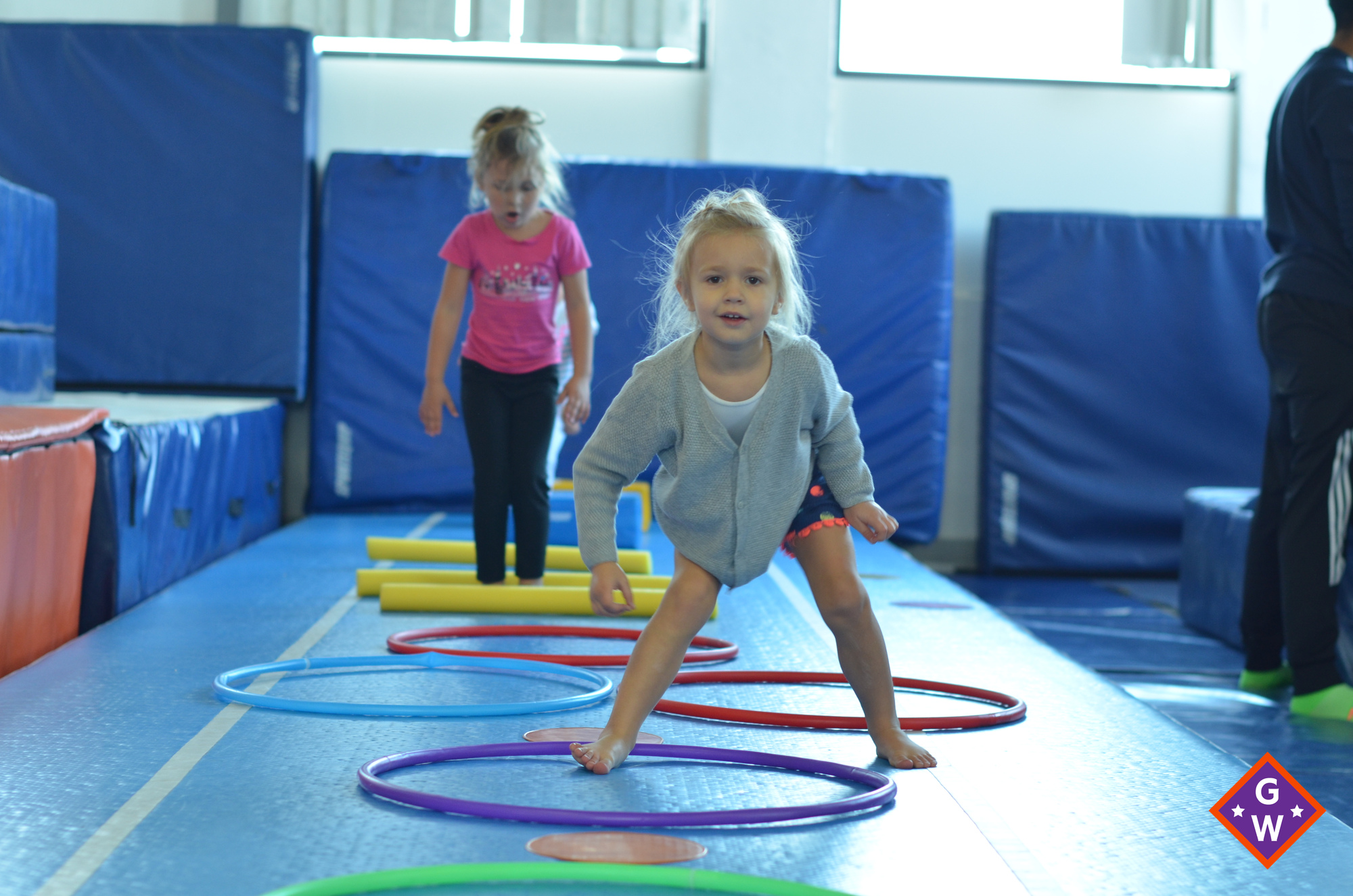
- Hoops, markers and balls. Equipment like hoops, poly dots (flat floor markers) and balls helps children place their bodies accurately, either to reach a target or to avoid one. Stepping in and out of a row of hoops, like the girl in the photo above, means judging where each foot needs to land.
- Ninja Parkour vaults. In the safety vault, children learn to clear a surface side-on with one hand down, judging how to shape their body to get over it. The surfaces get higher step by step.
- Left and right games. Cartwheels, rope work and games like Ships and Sailors and the Opposite Game, where children move the opposite way to what is called, ask them to think about left and right while they move. For more on reaching across the body, see crossing the midline.
These are built up gradually. The report describes a tiered curriculum in which children first practise basic body positions before moving on to more complex moving work, so bigger obstacles come later.
Space games to try at home
You do not need special equipment, just a clear, safe space and a few household things:
- Mini obstacle course: crawl under a table, step over a cushion, walk around a chair and climb through a big cardboard box. Say each word out loud as your child does it.
- Simon says, space edition: “Simon says put your hand on top of your head… behind your back… under your chin.”
- Mirror me: stand face to face and take turns copying each other’s slow movements.
- Stepping stones: on a carpet or grass, lay out hoops, chalk circles or flat cushions and step from one to the next. Cushions can slide on tiles, so save the jumping for hoops and chalk.
- Space bubbles: everyone stretches their arms out to make a “bubble”, then walks around the room without popping anyone else’s.
Keep it playful and let your child set the pace. Use soft, stable things that will not tip over, keep away from stairs and sharp corners, and stay close by. These ideas are for fun at home and are not a treatment plan. If your child has an injury or is receiving therapy, check with their treating professional first.
Every obstacle is practice
Gym Wizards uses a progression-based curriculum, so children build skills step by step at their own pace. Ducking under, stepping over and finding a way through are not things to test. They are part of the fun, practised a little more confidently each week.
Next time your child weaves through a crowded room without a bump, you will know their spatial awareness has been hard at work.
Ask your Gym Wizards instructor what obstacle course or rope game your child tried this week.
New to Gym Wizards? If you are looking at gymnastics or Ninja Parkour classes in Cape Town, ask about a trial class. Our team can help you choose between Kenridge, Pinelands and Llandudno and explain the booking and payment steps.
Source note: This article draws on Tiffany Heaney’s October 2020 occupational-therapy analysis of the Gym Wizards programme, especially printed pages 17–20 and 35. It describes opportunities to practise, not guaranteed developmental results. Gym Wizards does not replace occupational therapy, physiotherapy or speech therapy.