


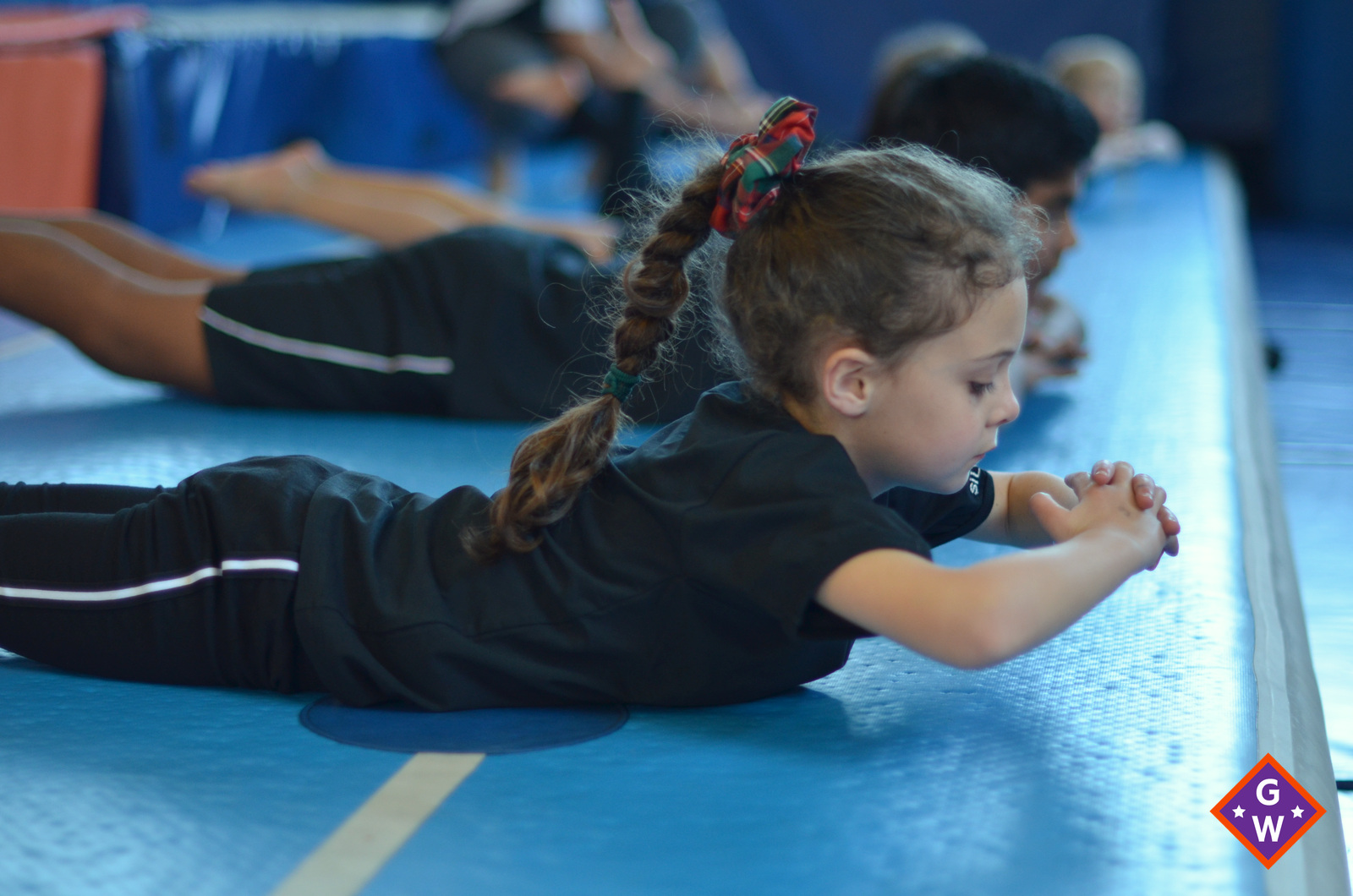

Imagine your child flopping onto their tummy on the lounge carpet, stretching both arms out in front and announcing that they are flying. Chest up, legs wobbling, a huge grin. It looks like a game, and it is. It is also core strength for kids in action: the middle of the body working hard so that the rest can play.
“Core strength” can sound like something for grown-ups in a gym. For children it is much simpler, and a lot more fun. Here is what the core is, why a steady middle matters, and how children get to practise it in class without it ever feeling like a workout.
What is the core?
In her analysis of the Gym Wizards curriculum, occupational therapist Tiffany Heaney describes the core as the muscles of the stomach and back, together with the muscles that surround and support the shoulders and hips. These muscles steady and move the trunk of the body. They act as a foundation for the arms and legs.
She also describes a principle of how movement develops: children gain control from the centre of the body outwards. Put simply, the middle comes first, and the hands and feet build on it.
Why a steady middle matters
The report links the core to many ordinary parts of a child’s day:
- Getting up and down: moving between the floor and standing, like after mat time at school.
- Playing: climbing and finding a way around a jungle gym.
- Running, jumping and hopping: the report says these big movements need strong core muscles.
- Sitting: staying upright at a desk or on the floor.
- Busy hands: the report describes the core as a stabilising base for the arms and hands during tasks like colouring in and cutting.
You might notice that some children slouch, lean on the table or fidget when they sit for a while. The Berkshire Healthcare NHS Foundation Trust guide to core stability lists these among the things parents may see. On its own, this is not a reason to worry. Children develop at different paces, and every child gets tired. If you have a concern about your child’s development, chat to your GP or an occupational therapist.
For another view on sitting and slouching, read guest writer Dr Chantel da Silva on why good posture is a skill, not a position.
Core strength for kids in Gym Wizards classes
According to the report, the Gym Wizards movement library has a whole section dedicated to core strength. The exercises are presented as fun games, often with a partner, so children want to join in. The report gives examples for each part of the core:
- Tummy: Crunches and Russian Twists.
- Back: the Arch Superman, and Angry Cat and Happy Cat.
- Shoulders: Shoulder Taps and Push Ups, plus anything that puts weight on the hands, like Handstand and Cartwheel practice.
- Hips: Step Ups and Squat Jumps.
- All together: Mountain Climbers, Inchworms and Bridge Kicks.
One partner game in the report is the Chinese Fan. Two children hold a Front Support position (like the top of a push-up) and move like a fan opening and closing, using their imagination as they go.
The report also notes that more complex movements, such as rolling and Ninja Parkour skills, are built on a strong core. Rolling also works the balance sense in the inner ear, which we explain in why kids love spinning, rolling and going upside down. Animal walks put weight on the arms and legs too, and you can read more in our article on animal walks and body awareness. The core also helps the arms do their part in balancing, which we explore in Balance for Kids: Why the Wobble Matters. Russian Twists and Shoulder Taps also involve reaching across the body, which we explain in crossing the midline.
Core play to try at home
You do not need equipment or a programme. A few playful ideas, adapted from the Berkshire Healthcare guide mentioned above:
- Aeroplane: lie on your tummy and lift your arms and legs off the floor. How long can the flight last?
- Bridge: lie on your back with knees bent and feet flat, then lift your hips and hold for a moment.
- Crab walk: sit with your hands behind you, lift your hips and walk like a crab.
- Log roll: lie down long and straight, then roll sideways across the floor.
Keep it light. Use a clear, non-slip space, stay close by, and stop if anything hurts. There is no need to count repetitions. These ideas are for fun at home and are not a treatment plan. If your child has an injury or is receiving therapy, check with their treating professional first.
Strong in the middle, ready for more
Gym Wizards uses a progression-based curriculum, so children build skills step by step at their own pace. Core strength is not something to test or rush. It gets practised quietly inside the holds, hops and games that make a class fun.
Next time your child “flies” across the lounge floor, you will know their middle is hard at work.
Ask your Gym Wizards instructor which core games your child has been enjoying in class.
New to Gym Wizards? If you are looking at gymnastics or Ninja Parkour classes in Cape Town, ask about a trial class. Our team can help you choose between Kenridge, Pinelands and Llandudno and explain the booking and payment steps.
Source note: This article draws on Tiffany Heaney’s October 2020 occupational-therapy analysis of the Gym Wizards programme, especially printed pages 15, 21–22 and 35. It describes opportunities to practise, not guaranteed developmental results. Gym Wizards does not replace occupational therapy, physiotherapy or speech therapy.

