
Imagine a favourite song coming on in the kitchen. Within seconds your child is bouncing, stomping, spinning and freezing at exactly the moment the music drops. Nobody taught them to do that. It is music and movement for kids at its simplest: a body hearing a beat and wanting to join in.
That urge to move to music is something Gym Wizards classes use on purpose. Here is how music fits into a class, what moving to a beat asks of a child, and some easy ways to play with rhythm at home.
How music fits into a Gym Wizards class
In her analysis of the Gym Wizards curriculum, occupational therapist Tiffany Heaney describes how instructors choose parts of each lesson to do to music. That could be:
- The warm-up, to get everyone moving together.
- Strength and fitness work, where a good song helps the effort along.
- Moving between activities, with the music acting as a guide from one activity to the next.
- During an activity, moving in time with the beat.
- The cool-down, to bring the energy back down.
In each case, children are asked to follow the rhythm and pace of the music and move to the beat.
Why moving to a beat is a skill
Keeping time with music looks effortless when adults do it, but for a child it brings several things together at once. They need to listen, notice the pattern in the music, and get their arms and legs to arrive at the right moment.
The report explains that children practise this in class through games with balls, skipping ropes, bean bags and hoops, where they move both their body and the object to the beat. Some songs come with a repeated move for every chorus, which helps children recognise the chorus by linking it to a movement. According to the report, moving in time like this helps children practise rhythm and timing, and it helps them learn set sequences of movements.
The report also describes rhythm and timing as part of many everyday moments, such as listening to instructions and responding to them, or chatting with friends. In class, instructors sometimes bring timing in directly, for example by counting how many runs over a skipping rope a child can do in 10 seconds.
Music makes the hard parts more fun
Music changes how effort feels. The report notes that it adds fun and motivation, and that it can encourage children to keep going when they feel tired or to try a little harder when something is tricky.
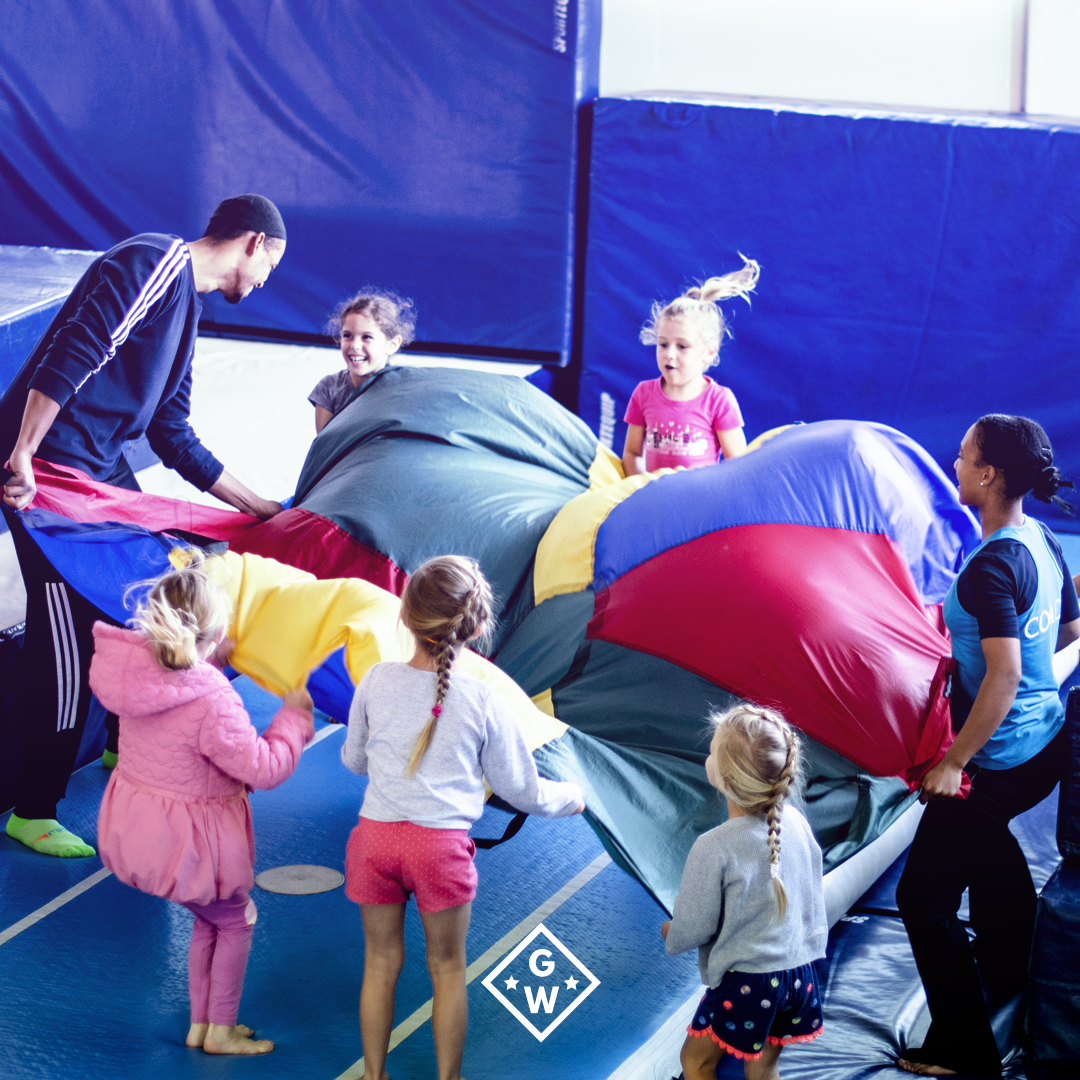
Group games work in a similar way. When children lift a parachute together, as in the photo above, everyone has to move at the same moment for it to billow. The report describes parachute games as a way for children to move both arms together towards a shared goal as a team.
Moving both sides of the body in a coordinated, rhythmic way is also linked to crossing the body’s centre line, which we explain in our article on crossing the midline. Rope skipping, one of the ways children move to a beat in class, comes up there too.
Music and movement to try at home
You do not need special equipment, just a few songs your child enjoys:
- Giants and mice: play a slow song and walk with big, heavy giant steps. Switch to a fast song and tiptoe quickly like a mouse.
- Chorus move: choose one move together, such as a star jump, a spin or a big clap. Every time the chorus comes round, everyone does it.
- Clap and copy: clap a short rhythm, then let your child copy it with claps, stomps or knee taps. Swap so they make one up for you.
- Pass the beat: sit in a circle and pass a bean bag or soft toy on every beat of the song.
If your child loves freezing when the music stops, you will find a one-footed freeze game in Balance for Kids: Why the Wobble Matters. For more playful movement at home, try the ideas in our article on animal walks and body awareness.
Keep it light. Use a clear, non-slip space and let your child choose the songs. There is no right way to dance and no need to get the beat perfect. These ideas are for fun at home and are not a treatment plan.
Every class has a rhythm
Gym Wizards uses a progression-based curriculum, so children build skills step by step at their own pace. Moving to music is not something to test or perfect. It is one more way to make practice feel like play.
Next time your child freezes mid-dance when the song drops, you will know there is real timing at work.
Ask your Gym Wizards instructor which songs your child’s class likes to warm up to.
New to Gym Wizards? If you are looking at gymnastics or Ninja Parkour classes in Cape Town, ask about a trial class. Our team can help you choose between Kenridge, Pinelands and Llandudno and explain the booking and payment steps.
Source note: This article draws on Tiffany Heaney’s October 2020 occupational-therapy analysis of the Gym Wizards programme, especially printed pages 26–27, 31–32 and 35. It describes opportunities to practise, not guaranteed developmental results. Gym Wizards does not replace occupational therapy, physiotherapy or speech therapy.