
Picture your child holding a piece of paper steady with one hand while the other hand cuts along a line with scissors. Or tying a shoelace, or catching a ball with both hands. Each of these jobs asks the two sides of the body to work together, each doing its own part. That teamwork has a name: bilateral coordination, and it is one of the quiet skills behind a great many everyday tasks.
Here is what bilateral coordination for kids means, the three ways the two sides of the body can work together, and how a Gym Wizards class gives children plenty of chances to practise.
What bilateral coordination is
In her analysis of the Gym Wizards programme, occupational therapist Tiffany Heaney uses the term bilateral integration. In plain words, it is the ability to coordinate movement on both sides of the body in an organised, controlled way, including hands, eyes, arms, legs and feet.
The report lists everyday tasks that draw on it, such as:
- fastening zips and buttons and tying shoelaces
- holding the page still with one hand while the other writes
- cutting along straight and curved lines
- throwing and catching a ball with both hands
- walking, climbing stairs, jumping with two feet and skipping
If you would like to read about a close cousin of this skill, see our article on crossing the midline, which is about reaching across the middle of the body.
Three ways the two sides can work together
The report describes bilateral coordination as developing in a sequence, in three stages:
1. Both sides do the same thing at the same time. Clapping, jumping with both feet together, or rolling out play dough with a rolling pin. The report calls this symmetrical. 2. The two sides do opposite things at the same time. Climbing stairs, riding a bicycle or skipping. One leg goes forward while the other goes back. The report calls this reciprocal. 3. Each side does a different job in the same activity. Cutting with scissors, or eating with a knife and fork. One hand steadies, the other is more active. The report calls this asymmetrical.
The report describes these as developing in this order, but every child grows at their own pace, and one tricky day is not a reason to worry on its own. If you ever have concerns about your child’s coordination, speak to your doctor or an occupational therapist.
Why a skipping rope is such a good teacher
The report points to rope skipping as a standout example. The legs jump in patterns that are sometimes the same on both sides and sometimes alternate. The arms have to keep the rope moving evenly between the right and left hands, and the arms and legs must be timed together so the feet clear the rope.
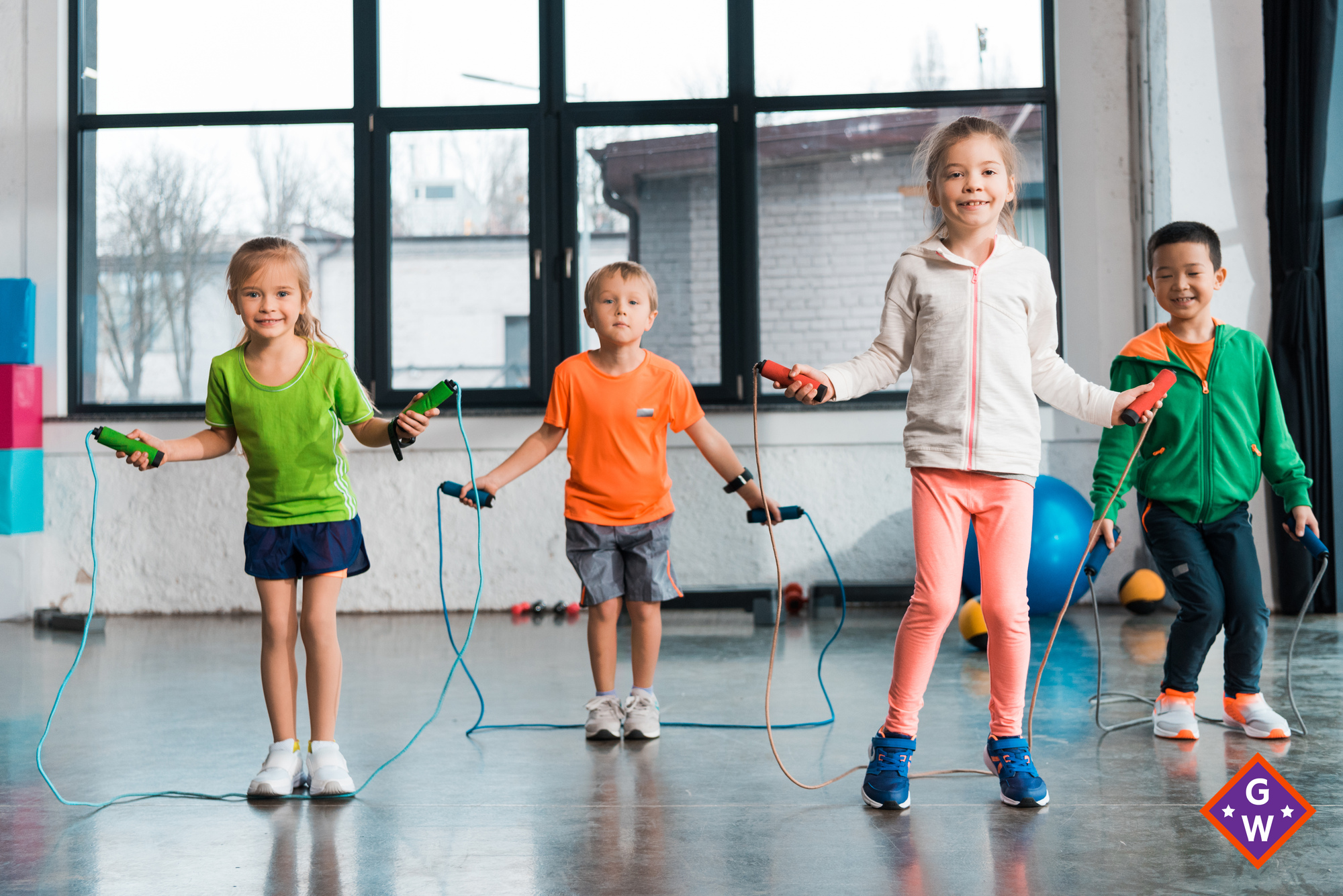
That is a lot of teamwork for one small piece of equipment. The report describes how Gym Wizards teaches rope jumping in small steps, so children can build these skills gradually and enjoy success along the way. The report describes children jumping forwards, backwards and side to side over a rope lying on the floor, and also learning a range of jumps with the rope in their hands. The children in the photo above are holding their ropes ready to start.
Other ways a class uses both sides
Rope work is only one place it shows up. The report mentions a few more:
- Locomotions. In the baboon, seal and bear walks, children move across an air track or long mat. The arms and legs have to push evenly on both sides, or they would not travel in a straight line.
- Arm swings for jumping. In a standing long jump, children learn to take their arms back as they bend their knees, then swing them forward together as they jump. Once that feels natural, it is used in more complex jumps and rebounds.
- Cartwheels. Both sides of the body move in a sequence while the head turns upside down and comes back up again.
- Parachute games. Children move their arms together towards a shared goal, such as tossing a ball up and catching it in the parachute.
From two sides to sequences
The report also notes that bilateral coordination comes before sequencing, which is putting movements in order. Even a simple two-foot jump is a little sequence: bend both knees together, push off through both feet, land. As children move through the curriculum, they first perfect basic body positions and then link them into longer combinations of hurdles, rebounds, jumps, rolls and landings.
The report suggests that practising sequences of movement is a stepping stone to sequencing in general, for example following instructions in order. These are possibilities, not promises. A class gives your child opportunities to practise, and each child builds the skill at their own pace.
Two-sided games to try at home
You do not need equipment, just a clear, safe space:
- Clapping patterns: clap together, then clap hands against knees, then cross arms and clap. Make up your own and swap who leads.
- Floor-rope hops: lay a skipping rope or a line of string straight on the floor. Hop over it with both feet together, then step over it one foot at a time, then jump sideways along it.
- Bear and crab walks: move across the lawn or a carpet on hands and feet. Check that the arms and legs are pushing evenly so you travel in a straight line.
- Scissors and paper: let your child hold the paper with one hand and cut with the other. Try thick paper at first, use child-safe scissors and always supervise.
- Jumping jacks and arm swings: count them out loud and add a little music.
- Parachute at home: hold the corners of an old sheet together and toss a soft ball into the air, then catch it in the sheet.
Keep it playful and let your child set the pace. Check the space for tripping hazards, stay close by, and stop if anything hurts. These ideas are for fun and are not a treatment plan. If your child has an injury or is receiving therapy, check with their treating professional first.
Practice that feels like play
Gym Wizards uses a progression-based curriculum, so children build skills step by step. Skipping, jumping and rolling are not tests. They are a chance to learn how the two sides of the body can team up, with music, games and friends. We write about the part music plays in music and movement for kids.
Next time your child holds the paper steady while they cut, or finally gets the rope over their head and under their feet, you will know both sides of their body have been busy learning to work as a team.
Ask your Gym Wizards instructor which skipping or two-sided activities your child has been enjoying in class.
New to Gym Wizards? If you are looking at gymnastics or Ninja Parkour classes in Cape Town, ask about a trial class. Our team can help you choose between Kenridge, Pinelands and Llandudno and explain the booking and payment steps.
Source note: This article draws on Tiffany Heaney’s October 2020 occupational-therapy analysis of the Gym Wizards programme, especially printed pages 10, 12, 25–29 and 35. It describes opportunities to practise, not guaranteed developmental results. Gym Wizards does not replace occupational therapy, physiotherapy or speech therapy.